Posts

Showing posts with the label e) Japan’s Economic Outlook

Japan’s COVID cases on the rise pose a risk to derail its economy again

Image
Bank of Japan released data on July 12 that showed wholesale prices in Japan jumped 9.2 percent in June from a year earlier as import prices surged at the fastest pace on record due to plummeting value in the yen. The yen's recent depreciation unseen in about two decades against the U.S. dollar pushed up import prices hurting resource-poor Japan’s economy. The core consumer price index excluding volatile fresh food items rose 2.1 percent in April and May, a level above the BOJ's target of 2 percent. Japanese companies and consumers are feeling the impact of rising prices.  Japan's health experts warn of an explosive increase in the number of new coronavirus cases To make matters worse, recent abrupt increase in the number of new coronavirus cases pose another risk to Japan’s economy. The explosive increase in new covid cases in Japan makes healthcare professionals in Japan seriously worry. Japan found a record 110,600 new cases on July 15, surpassing the previous high set...

Rising energy price, depreciating Yen and power shortage pose an ordeal for Japan’ economy

Image
Electricity network in Tokyo was on the brink of a large-scale power outage in late March. The power supply is being imminent challenges for Japan’s economy. In late March, the Japanese government issued the first-ever warning over electricity availability for the first time in history, asking households and companies to cooperate in saving electricity, saying that the tight power supply and strong demand in Tokyo and the Tohoku region could lead to a large-scale power outage as some power plants remain offline following an earthquake that occurred in the Tohoku region on March 16. Larger than usual electricity consumption due to cold weather in late March also reduced spare capacity of power supply in the region. The supply capacity of Japanese electric power companies has been lacking for several years since many of Japan's nuclear reactors have been offline under stricter regulations introduced after the Great East Japan Earthquake in 2011 leaving the country dependent on ther...

Price hikes bite Japanese businesses and households

Image
High street price rises as wholesale inflation accelerates at record rates Japanese consumers are facing challenges as a wave of price hikes will hit essential items such as food and daily goods in the new fiscal year beginning on April 1 due to the rising cost of raw materials.  Higher material costs are also squeezing corporate earnings in Japan. For example, Aeon Co., Ltd., the biggest operator of general merchandise stores in Japan announced that its operating profit for the fiscal year ending February 2022 decreased from 200 billion yen to 173 billion yen, and its final profit fell to 6 billion yen from 20 billion yen.  On the other hand, Aeon’s sales have increased from 8.62 trillion yen to 8.71 trillion yen, indicating that Aeon's profit margin is declining. Japanese companies have been gradually passing on surging costs to consumers by raising retail prices, a change from their cautious stance on price hikes for fear of hurting demand, however the pass-through seems ...

The Japanese Economy may overcome obstacles and keep its recovery on track

Image
Foreign visitors to Japan plunged to record low harming tourism in Japan Japan confirmed 102,333 new COVID-19 cases on February 5, for the highest daily count although the speed of infections is gradually slowing down and some researchers think it is peaking out.  The spread of coronavirus infection is affecting the tourism industry again. Travel restrictions to prevent the spread of COVID-19 have throttled Japan's tourism industry with the estimated number of foreign visitors plummeting to an all-time low of 245,900 in 2021.  The number of guests who stayed at hotels and other accommodation facilities in Japan hit a record low last year for the second straight year because of prolonged border controls and a slowdown in the recovery of domestic travel demand. The cumulative total of guests at hotels and inns was 315.75 million in 2021, down 4.8 percent from 2020 and 47.0 percent from 2019, according to preliminary data recently announced by the Japanese government.  The...

Japan's Economy: COVID-19 state of emergency was lifted in Japan but industries are still facing bleak business conditions

Image
Incoming Japanese PM stimulates the economy with COVID-19 state of emergency covering Japan lifted The Japanese government has lifted the COVID-19 state of emergency covering Tokyo and 18 other prefectures, as well as the quasi-state of emergency in other areas on September 30, as new cases have declined from their peak.  From October 1, none of the country's 47 prefectures is under a state of emergency nor quasi-state of emergency for the first time since April 4. Now restaurants and other dining establishments are allowed to serve alcohol until 8 p.m. and remain open until 9 p.m. as long as they take anti-virus measures.  If infections settle down further, all regulations are expected to be eliminated in the months to come. Kishida, who will be named as Prime Minister in the Diet on October 4, thanks to the LDP-led coalition power to control both chambers said he envisions a further easing of restrictions around November when more people have been fully vaccinated. He is...

Political changes raised hopes for new policies to contain COVID-19 and propel economic rebounds

Image
Japanese PM resigns at the end of September with the state of emergency to be extended Japanese Prime Minister Yoshihide Suga revealed his intention to resign as ruling Liberal Democratic Party support erodes and public criticism over his response to the COVID-19 pandemic mounts diminishing his chances of winning a second term.  Prime Minister Suga announced on September 3 that he would not run for the LDP presidential election scheduled at the end of September. In the Liberal Democratic Party, which is in charge of the current Japanese administration, it is customary for the prime minister to be the president of the party, so the fact that Prime Minister Suga does not run for the presidential election means he will resign at the end of September.  Suga explained the reason for his decision not to run for the election was to devote himself to the containing measures against the new coronavirus. At present there is no prospect seen to eradicate the pandemic any time soon in J...

Covid 19 virus spike hits Japan’s travel and railroad companies amid Tokyo Olympics

Image
Foreign visitors to Japan have plummeted caused by restrictions on cross-border traffic Japan National Tourism Organization announced on July 21 that the estimated number of foreign visitors to Japan in June 2021 was 9,300, 99.7% decrease compared to the same month of 2019 before the spread of COVID-19.  Dramatic plunge in foreign tourists was caused by restriction measures on cross-border traffic to contain COVID-19 infection. Travelers to Japan for tourism purposes are still not permitted to enter the country, unless exceptional circumstances are found.  As for the first half of 2021, the number of foreign visitors to Japan was 96,300, a decrease of 99.4% from the same period of 2019.  Japan has strengthened quarantine measures for visitors to the country to cope with the spread of COVID-19 infection since late January 2020. Since then, the number of newly cases of COVID-19 repeated ups and downs forcing the government to strengthen and mitigate its preventive measure...

Business sentiment hit highest although Tokyo Olympics without spectators may worsen consumer sentiment

Image
Japan’s business sentiment rises fourth straight quarters led by exports According to the Bank of Japan's latest “Tankan” quarterly survey released in June which shows a short-term economic outlook of enterprises in Japan, the index showing business sentiment of large manufacturing companies was plus 14 points, 9 points higher than the previous survey and improved for the fourth consecutive quarter.  The index for large manufacturers was the highest in two and a half years since the December 2018 survey. The plethora of sectors in the large manufacturing industry remained optimistic thanks to the backdrop of increasing exports accompanying the recovery of overseas economies.  For example, the index of general-purpose machinery sector such as turbines rose by 34 points and the index of electrical machinery by 28 points. On the other hand, the production of automobiles has deteriorated by 7 points due to the suspension of production at the factory due to the shortage of semico...

Japan's Economy: Nikkei 225 finally topped 30,000 yen for the first time since August 1990 while Toyota Motor posted highest quarterly financial results in five years

Image
Nikkei surge reminds investors of bubble era high On February 15, Japan’s Nikkei 225 Stock Average has finally breached 30,000 yen for the first time since August 1990, after it has repeated to hit record highs on several days in February back up through levels not seen since the collapse of the bubble economy.  Having positive outlook for the medium to long term, overseas investors who have been late to buy stocks are jumping into the market driving up stock prices. Looking at the announcement of financial results for the first three quarters of the current business year, which began in earnest in February, rebounding sales and profits of domestic companies centered on the manufacturing industry became more apparent.  The planed vaccination rollout of the new coronavirus and expectation for continued stimulating fiscal policy are also revitalizing economic activities and support optimistic outlook for the future business performance. On February 12, barrage of financial res...

Japan’s Economy: A tug of war between COVID-19 resurgence and strong export over economic recovery

Image
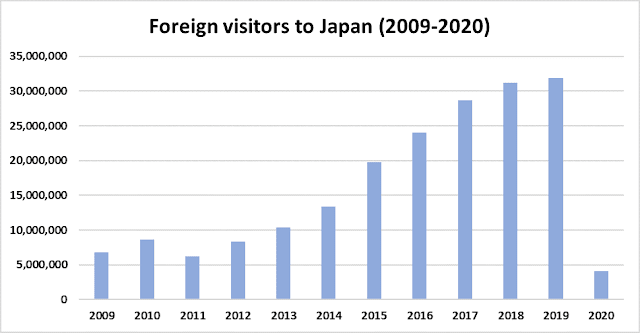
Tourism industry, retailers and restaurants were hit again by the pandemic The new coronavirus infections in Japan continue to spread. On January 13, the government issued the state of emergency again in 11 prefectures, including Tokyo and neighboring three prefectures. The pandemic is causing great damage to the tourism industry, one of Japan's major industries.  The Japan National Tourism Organization announced that the number of foreign tourists visiting Japan in 2020 was 4,115,900, a decrease of 87.1% from the previous year. It was the lowest level since 1998, and the rate of decline was the largest since 1964 when the statistics began. In particular, the number of foreign tourists in April has decreased by 99.9% from the previous year after the first state of emergency was declared, and has continued to decline for four consecutive months by the same ratio since then.  The economies of major tourist destinations in Japan, supported by the profits generated by foreign vi...

Japanese government asks citizens to stay home in New Year’s Day after the newly infected cases reached a record high

Image
The third wave of infections continue to sweep through the country The Tokyo Metropolitan Government announced on December 31 that the number of daily confirmed new cases of coronavirus infection was 1,337, significantly higher than the record high of 949 marked on December 26. The number of newly infected people in Japan also reached a record high of 4,519 as of December 31, surpassing 4,000 for the first time deepening concerns about hospital capacity.  The Governor of Tokyo called on the citizens of Tokyo to spend the New Year quietly with their families at home and asked to refrain from going out unnecessarily and to forgo dining out for New Year's party. In addition, she said if the spread of the infection could not be contained, she would have to request the Japanese government to declare the state of emergency.  The number of hospitalized coronavirus patients in Tokyo hit a record high and the number of people with serious symptoms has also reached a new high since a ...

Japan’s Economy: Business sentiment has improved significantly with expectations for the economy recovering from a year-long recession.

Image
  The Bank of Japan’s “ Tankan” quarterly survey suggests business sentiment has rebounded across the board According to the Bank of Japan's latest “Tankan” quarterly survey released in December which shows a short-term economic outlook of enterprises in Japan, business sentiment has improved sharply with expectations that Japanese economy is recovering from a year-long recession.  The Tankan reported rebounds in all categories, both manufacturing and nonmanufacturing companies, large and small. The index of business conditions among large manufacturers rose to minus 10 from minus 27, while business sentiment among large non-manufacturers such as service industries rose to minus 5 from minus 12.  The index for large manufacturers has improved for the second consecutive term and the extent of improvement was the largest since the June 2002 survey. The recovery in exports and production such as automobiles drove the improvement in business sentiment amid resumption of eco...